
Pave the Way
Cleanliness is self-reinforcing. A clean street communicates: someone is looking after this place. A dirty street communicates: nobody is looking after this place. Clean streets create less littering, more safety, more investment, more tourism, and therefore, more money for everyone.
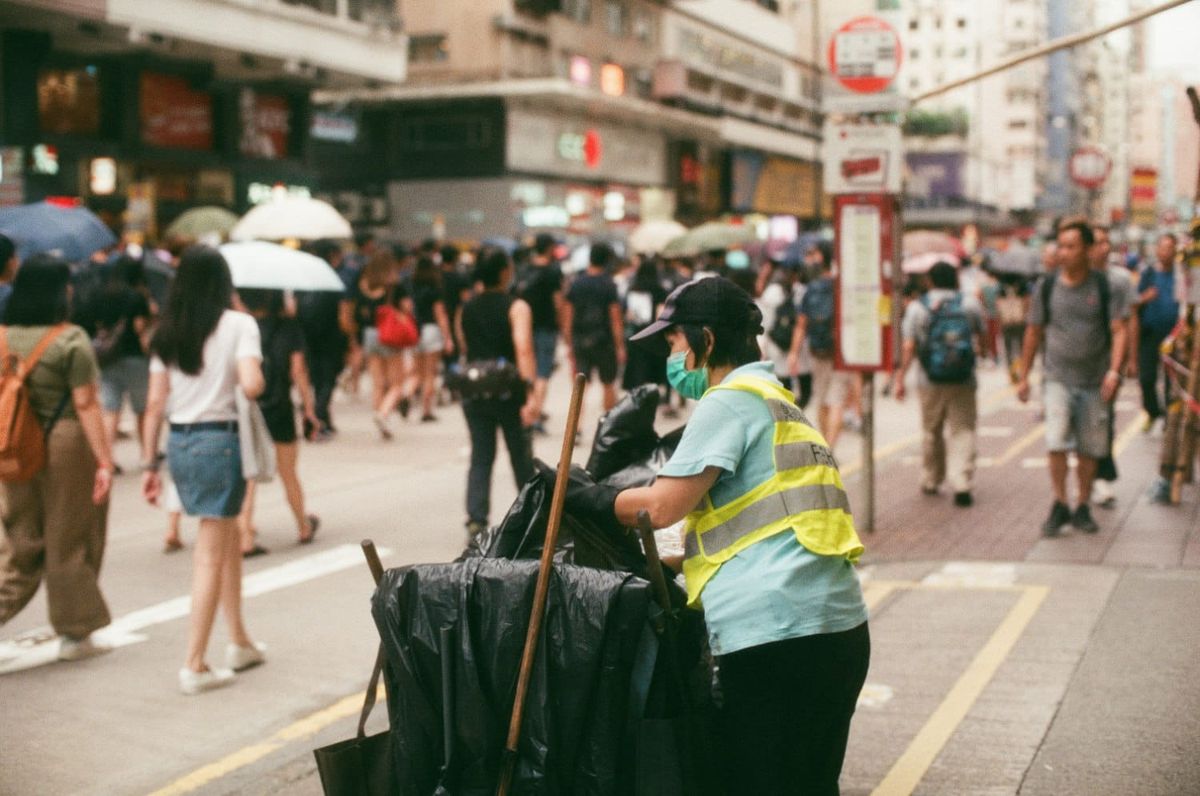
Cleaning the streets of Johannesburg.
In Hong Kong, street cleaning is major stuff. In Johannesburg it is not.
Let's look at the numbers.
Pikitup, the Johannesburg agency entrusted with waste management, says it hires over 4 500 people and cleans and sweeps over 9 000km of streets. These numbers are from Pikitup's own website. But, the website also references, as its lodestar, the Johannesburg GDS (Growth & Development Strategy) 2040, which was set up in 2011 and has basically failed ever since. The GDS has failed, and other than Pikitup mostly managing to come around in trucks to empty your wheelie bins, there's not much cleaning happening on a regular basis. Let alone ever. Have you ever seen people sweeping the streets other than those hired by private home or business owners or "City Improvement Districts"?
City Improvement Districts or Management Districts are private, independent groups powered by companies that get together to pay someone to sort out what the City of Johannesburg should be doing.
Pikitup sometimes (hardly ever) sends out a few workers – mainly women – into an area armed with rubbish bags to collect some of the litter strewn about, but this is never regular enough and does not include sweeping the streets.
Street sweeping in Johannesburg? Forget about it. Mostly we have dishevelled, dusty streets in our city.
It shouldn't be that hard. It's not that hard.
Let's look at Hong Kong.
In Hong Kong, the Food and Environmental Hygiene Department (FEHD) says it and its contractors employ more than 13 000 people across cleaning services, which include street sweeping and washing, waste collection, gully cleaning and public toilets. Hong Kong has a public road network of around 2 266km. Neither the FEHD nor Pikitup publishes how many workers are dedicated specifically to street sweeping. But with Hong Kong's workforce almost triple the size of Pikitup's entire workforce, operating across a road network roughly a quarter of Johannesburg's 9 000km, Pikitup's predominantly waste-collection model is simply not designed to provide the level of visible street maintenance that Johannesburg deserves.
And they actually sweep the streets in Hong Kong. From the FEHD's website:
Every street is manually swept at least once every day.
In commercial and tourist areas: it is swept four times a day on average.
In exceptionally busy pedestrian areas: up to eight times a day.
And this isn't just a target on a useless strategy document.
Hong Kong's published performance figures for January to June 2026 report 100% achievement of the target to sweep streets and empty litter bins. It is true – you only need to visit Hong Kong to see it for yourself.
How does Hong Kong do it? It just does. We're not even going to get into it. It is not rocket science.
Is there a solution for Joburg streets?
Pikitup's 2026/27 budget is approximately R5.3 billion. Its actual 2024/25 operational expenditure was approximately R3.72 billion. Do you think we could get, say, a R600 million labour programme out of that? It would be 11.3% of the 2026/27 Pikitup budget.
What would R600m get us?
At the current national minimum wage of R30.23 an hour, a hypothetical workforce of 5 400 dedicated street cleaners, being 40 per ward across Johannesburg's 135 wards, would cost about R340m a year in basic wages. Once you add in 135 managers, 135 dedicated bakkies, equipment, protective clothing and waste disposal, a programme of this scale might plausibly cost in the region of R600m a year. That would mean 5 400 people earning R5 240 per month and 135 people earning R50 000 per month in basic wages. It would also mean that residents of Johannesburg would see people cleaning the streets on a daily basis. The streets of Johannesburg are different from the streets of Hong Kong. So street cleaning in Joburg would entail maintaining streets, pavements, gullies, and removing weeds and litter. Even a splash of paint here and there could be part of the job.
Could it be done without it all coming crashing down where most of the workers never pitch for work and still get paid, where managers outsource their jobs and the streets are never clean? Where corruption engulfs the concept and R600m a year actually only results in a couple of people getting new Lamborghinis and a mansion in Zimbali?
Yes. It can be done without the corruption. Here's how. Hong Kong outsources around 82% of its street cleaning services to private contractors. The private contractors are mandated to hire according to standards and clean dedicated areas, and are monitored and inspected by the FEHD. Not performing or meeting the requirements? Funds are deducted and a contractor can become ineligible for future contracts. And contractors could be held to account by people not associated with a government agency – the residents and business owners in the area which the contractor has to maintain.
For our own hypothetical solution a private contractor would cost a bit more than our numbers. There'd need to be a profit for a private company. But it's already happening in Johannesburg by a Non-Profit Organisation which now needs more attention, and some proper funding.
Hello Pave the Way!
There are people in this city, our most inspiring city, who just get on with it and make a change. One of those people is Carly Kay, who has teamed up with a charity called Cross the Divide to take jobless men and give them work. It is called Pave the Way. It is simple work, but it is work that provides an income and a meal each day for the 25 or 26 men who get to work cleaning streets.
Part of my thinking when Pave the Way was born was a desire to show my immediate community, and wider communities, that ordinary people can make a difference, in whatever way, shape or form – Carly Kay, Pave the Way
Everything that Pave the Way does, from sweeping streets, pavements and gullies, to clearing weeds and overgrowth, to removing litter and rubble, is paid for through donations and sponsorships (the sponsorship link is below). At the moment, as of August 2026, it is predominantly individuals providing the sponsorships. Pave the Way needs more. It needs business to get involved with money or equipment. It needs its own truck or bakkie. Carly's plan is to grow Pave the Way into hubs in different areas, providing jobs and cleaning streets.
This works. It is doable. It needs the city and the government to get involved, along with private businesses, and Get. It. Done. With the right support it could even repair streets and pavements, maintaining them constantly. Imagine 135 versions of Pave the Way, and the WHOLE of Johannesburg would be clean, every day. It doesn't even need to be 135 – that is a hypothetical concept (although why couldn't there be 135?). And it also needn't only be men who do the cleaning. In Hong Kong, the cleaning workforce is made up heavily of people over the age of 60 and very often women.
The model works - creating job opportunities through entry level but hugely impactful work – Carly Kay, Pave the Way
There is no reason why there cannot be solutions to the problems in our city.
In the end, we love Johannesburg and want it to thrive. For the thriving of the city means the upliftment of our way of life. For all of us. We have some bright minds working on solutions to our myriad problems. But there is one thing that can make an immense difference to everyone. In our busy daily lives, it is actually a very small thing, but clean streets set up many structures far more important than just a feeling of things being in order. Clean streets mean that someone cares. Clean streets make people more hesitant to continue messing in them. Clean streets create pride in our city. Clean streets provide jobs. More people outside will also mean safer streets. And therefore more people happy to be out and about. And therefore spending money. And tourists will feel the same. And investors will want in on it. Clean streets are the starting point.
It is widely written that mayors around the world make vast promises and often fail to fulfil them, mainly because change takes time, and a four-to-five-year term is often not enough time to make lasting changes. So instead of promising everything, if the new mayor in Joburg achieves only one thing, it will change the trajectory of Johannesburg forever. And that thing is: fix the roads, pavements and related infrastructure such as bins, traffic lights and street lights. And not just fix it once, set up ongoing cleaning and maintenance programmes so it never gets out of control again.
Clean our streets, and a lot of good will follow. It can be done.
Thanks to Carly Kay of Pave the Way for agreeing to be interviewed. The most pressing need at the moment in order to continue their work is funding. Businesses could easily help with R10 000 per month in exchange for a Section 18A tax certificate provided through Cross the Divide, a registered NPO. What would also be a massive help is a bakkie or small truck. Carly, with Sue Winkler and Jeremy Redfearn from Cross the Divide, load up men and tools into their private cars and go backwards and forwards delivering them to cleaning sites! Come now, this is crazy. Who's going to be first to provide them with a heavy-duty vehicle?
For individuals or smaller business donations, the most pressing need is for refuse bags, spades, brooms, rakes, scrapers and, of course, funding.
To get involved or donate,

Comments ()